
A Smarter Way to Build Data Infrastructure
Stanford's Intelligence Per Watt programme finds 77% of AI requests are everyday tasks that could run on local hardware. Microsoft BitNet runs models like these on CPUs at up to 96% less energy. Net-Positive Data Centers (NPDC) is a proposal for a distributed-compute architecture to host them — community-governed, citation-anchored, and designed for the infrastructure decade ahead.
Distributed by design
Centralised hyperscale concentrates risk. A federated mesh of 100 kW nodes is designed to degrade gracefully.
Concentration is a single point of failureCommunity-governed
Host-community councils hold binding veto. Partnership, not extraction.
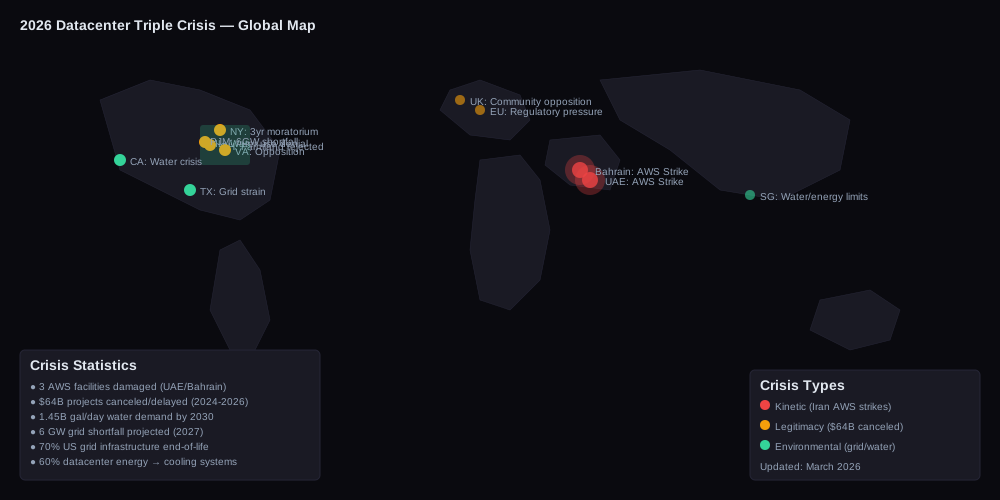
$64B in projects blocked or delayed by community oppositionNet-positive resources
Waste heat and recycled water return to the host community as measurable benefit.
1.45B gal/day projected demand by 2030The convergence is measured, not asserted
Three independent research threads — Stanford's Intelligence Per Watt programme, Microsoft's BitNet 1-bit LLM framework, and Dr Luci Attala's water anthropology — converge on the same conclusion: distributed, low-power, community-governed compute infrastructure is both technically superior and ethically necessary. NPDC is the architecture that answers all three.
Intelligence Per Watt
77% of AI requests are practical tasks well-suited to local models (≤20B parameters), which answer 88.7% of single-turn queries. Hybrid local-plus-cloud routing cuts energy roughly 64% and cost roughly 59% in the Stanford study. Read the summary.
1-bit LLMs on CPUs
BitNet b1.58 runs at 96% less energy than full-precision peers. Ternary weights, 0.4 GB memory, outperforms LLaMA 3.2 1B on standard benchmarks — and runs on commodity CPUs without GPU farms. Read the summary.
Water as constitutive force
Dr Luci Attala's three case studies — Wales, Kenya, Spain — establish water as a constitutive human force, not a resource to extract. Hyperscale water consumption is therefore cultural extraction, not just environmental cost. Read the summary.
Single points of failure
Hyperscale concentrates compute in a handful of megacampuses, so a single regional disruption becomes a systemic outage. A distributed mesh is designed to degrade by single-digit percentages instead of failing whole.
$64B blocked or delayed
By Data Center Watch's count, roughly $64 billion in planned hyperscale projects has been blocked ($18B) or delayed ($46B) amid local opposition over water, land, and grid cost. The legitimacy floor has moved.
6 GW grid shortfall
PJM Interconnection projects a 6 GW capacity shortfall across 13 states. Operators who reduce grid dependence — distributed load, on-site solar, waste-heat recovery — gain structural advantage.
Four pillars, one architecture
Net-Positive Data Centers operates as a distributed-compute architecture across four reinforcing pillars. Each pillar is anchored in one of the convergence research threads above. Together they describe an infrastructure built for the next decade, not the last one.
Epistemic Governance
Compute allocation is treated as a knowledge-justice question, not an engineering optimisation. NPDC's seven-dimensional governance layer (Historical, Indigenous, Cross-cultural, Scientific, Artistic, Marginalised, Future-generational) routes priority compute to underserved knowledge frameworks. Stanford's Intelligence Per Watt finding — that 77% of requests could run locally — makes this allocation tractable in a way it never was on hyperscale.
- Priority queues for Global South researchers and indigenous institutions
- Long-term climate modelling over short-term commercial inference
- CognioEngine integration for dimensional balance
Distributed Resilience
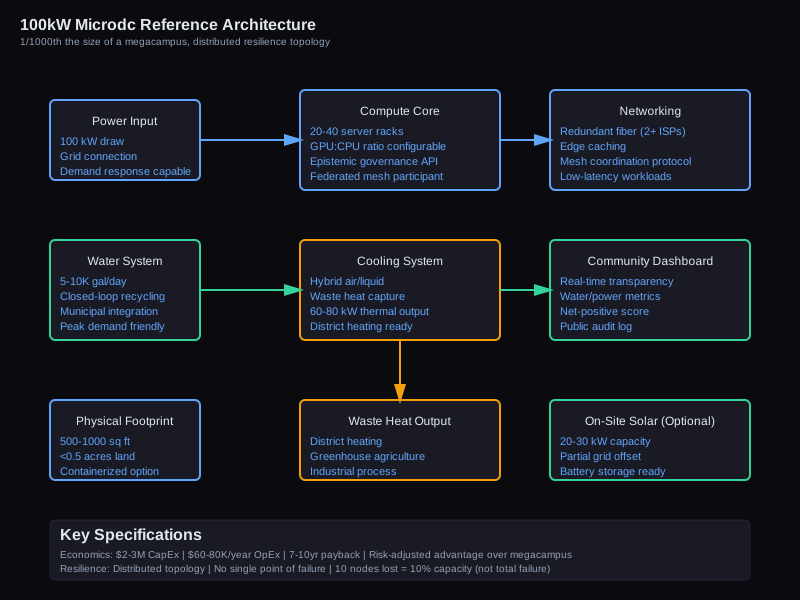
A federated mesh of 100–500 kW nodes replaces the megacampus. Where hyperscale concentrates compute so that a single regional disruption becomes a systemic outage, a distributed model is designed to absorb the same event at single-digit cost. Stanford's hybrid local-plus-cloud routing model maps directly to this mesh: local nodes handle the practical 77%; cloud escalation handles the residual.
- No concentration risk: ten nodes offline equals ten percent capacity, not total failure
- Distributed grid and water load — no single community absorbs the spike
- Federated routing across 50–100 nodes per regional cluster
Symbiotic Resources
Measurable net-positive returns to host communities. Waste heat routes to district heating or greenhouse agriculture; recycled water augments municipal supply; revenue-shares from compute flow to local government. Microsoft BitNet eliminates the GPU dependency that made hyperscale water-hungry — 96% less energy and CPU-only operation mean a 100 kW NPDC node does not need a reservoir to run inference. Attala's water anthropology grounds the principle: extraction is cultural violence; return is civic infrastructure.
- Waste heat to district heating, greenhouse agriculture, or industrial process
- Water recycling returns to municipal supply at greater-than-input volume
- Revenue-sharing on compute sales flows to host-community council
Transparent Governance
Real-time public dashboards expose water, power, and heat at the node level. Quarterly audits land binding recommendations. Most consequentially, the reversibility clause: a host-community council can trigger decommissioning at NPDC's expense if the net-positive metrics — co-defined with the council at deployment — are not met after twelve months. Trust is not asserted; it is engineered.
- Real-time public dashboards for water, power, heat, and revenue-share at each node
- Quarterly audits with binding recommendations
- Reversibility clause: community can trigger decommissioning at NPDC expense
Megacampus vs MicroDC mesh
| Metric | Megacampus (current) | MicroDC mesh (NPDC) |
|---|---|---|
| Power draw | 100+ MW per site | 100–500 kW per node × 50–100 nodes |
| Water use | ~5M gallons/day | 5–10k gallons/day per node, distributed |
| Land footprint | 300+ acres | Under 0.5 acres per node |
| Concentration risk | Single point of failure | No single node is critical |
| Grid impact | Spike requires major upgrade | Distributed load absorbs without upgrade |
| Community benefit | Minimal jobs, concentrated tax | Jobs, waste heat, revenue-share, water recycling |
| Governance | Corporate; no community veto | Tri-partite: investors, community, epistemic stakeholders |
| Reversibility | None (sunk cost) | Community can trigger decommissioning if metrics unmet |
Community-governed, net-positive returns
NPDC is the first data-centre architecture designed to return more value than it takes — measurably, transparently, reversibly. The calculator and governance model are the load-bearing primitives.
The Net-Positive Calculator
Community costs (inputs)
- Water consumed (gallons/day)
- Power consumed (kWh/day)
- Land occupied (acres)
- Utility-rate impact ($/household/month)
Community benefits (outputs)
- Jobs created (FTE local employment)
- Tax revenue (property + income)
- Waste heat delivered (kWh thermal value)
- Water recycled (gallons returned)
- Subsidised compute access (schools, libraries, non-profits)
Target: > 0.2 (20% net-positive)
Accountability: < 0.0 (extractive) → host-community council can trigger decommissioning
Tri-partite governance
Three stakeholder seats; no single seat can override the others. Decisions require consensus across all three.
Investors
Provide capital. Vote on technical and financial decisions.
Host communities
Provide land, resources, legitimacy. Binding veto over deployment and continuation.
Epistemic stakeholders
Universities, indigenous institutions, Global South researchers. Define knowledge priorities.
No single stakeholder overrides the others. Decisions require consensus across all three seats.
The 2026 pilot programme
NPDC is seeking one forward-thinking host community to deploy the first 100 kW MicroDC reference node.
Requirements
- A host-community council willing to co-define net-positive metrics
- Local government open to consortium co-design
- Existing grid capacity for a 100 kW draw
- A real use case for waste heat (district heating, greenhouse, industrial process)
What the host community gets
- Net-positive metrics co-defined by the council at deployment
- Binding veto over continuation after the twelve-month review
- Real-time public dashboard (water, power, heat, revenue-share)
- Revenue-sharing on compute sales
- Waste heat delivered to the council-nominated use case
- Decommissioning at NPDC expense if net-positive targets are not met
The consortium
Three pathways to participate. Each seat carries a different responsibility; each carries a different vote.
For investors
The distributed model is risk-adjusted in NPDC's favour:
- Lower concentration risk: no single high-value site
- Lower political risk: community governance builds durable consent
- First-mover advantage in the post-megacampus architecture
Seat: capital contribution plus a voting seat on financial and technical decisions.
Enquire about consortium membershipFor host communities
A genuine partnership model, not a host-fee transaction:
- Measurable net-positive returns, calculator-verified
- Binding veto: the council governs, not just hosts
- Reversibility: decommissioning at NPDC expense if metrics are not met
- A template for epistemic and resource sovereignty
Seat: hosting a node plus a voting seat on deployment and continuation.
Apply to the 2026 pilot programmeFor epistemic stakeholders
The first data-centre architecture treating compute as knowledge justice:
- Seven-dimensional governance: Historical, Indigenous, Cross-cultural, Scientific, Artistic, Marginalised, Future-generational
- Priority compute access for underserved knowledge frameworks
- Cogniosynthesis principles embedded in infrastructure decisions
Seat: universities, indigenous institutions, Global South researchers. Voting seat on epistemic priorities.
Enquire about epistemic partnershipThe technical whitepaper
Net-Positive Data Centers v1 is in preparation. It will cover the 100 kW MicroDC reference architecture, the epistemic-governance API, the community value-return calculator, distributed-resilience analysis, and regulatory strategy.
The whitepaper does not yet exist as a published document. Leave an email and NPDC will write to you the day v1 publishes.
Until then, the proof is live: the news relevance feed scores CognioNews stories against the architecture's terms and surfaces every public dispatch that maps to the NPDC thesis. Read the evidence before the document.
Get involved
Net-Positive Data Centers Consortium
Distributed-compute infrastructure as civic architecture.
Email: consortium@netpositivedatacenters.org
Research: The convergence dossier